
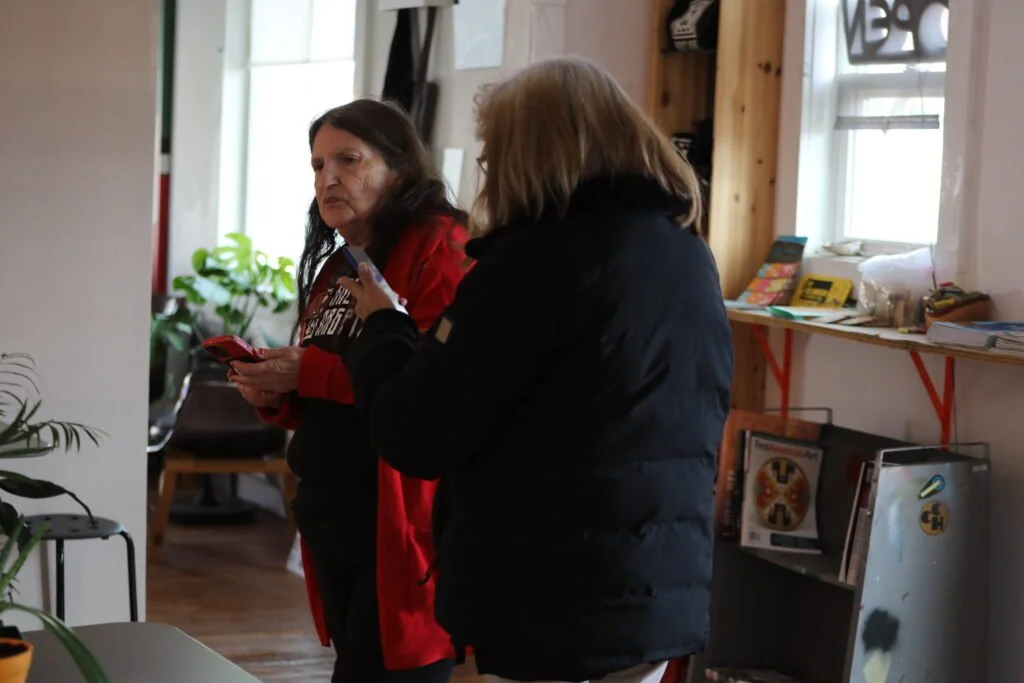
Marlyce Miner (left) and Dollie Red Elk
Link: https://artsmidwest.org/stories/racing-magpie-lakota-elders-in-residence/
October 7, 2026
Racing Magpie's current elders-in-residence, Dollie Red Elk and Marlyce Miner coordinate with local artists to put on community workshops like paper quilling.
A pilot program at Racing Magpie in Rapid City works with Lakota elders to share language and foodways ‘to honor them as cultural leaders.’
Office hours with community elders?
This South Dakota arts and culture organization is serving as a how-to.
Rapid City’s Racing Magpie is a Lakota-centric nonprofit. It has artist studios, a gallery, community space and garden, and its newest addition: the Elder-in-Residence program.
“The whole point of being Lakota is that your elders inform who you are and they inform what the future generation is going to be like, essentially,” says program curator Rae Schad. “So in our eyes, our elders-in-residence program is a way for us to have elders in our building.”
That, Schad says, makes for intergenerational learning and planning for the hereafter more valuable.
Racing Magpie’s Rae Schad has advice for other organizations looking to follow suit with an elder-in-residence program: Ask your community what it wants to see.
Currently, two elders spend most weekdays at Racing Magpie. They greet visitors and answer questions, host Lakota language conversation circles, run the community garden, and help plan cultural events and classes.
In its pilot year, there’ve been sewing circles, history lessons, culinary classes, and art workshops. And the resident elders are paid for their time, knowledge, and stories.
“How do we really keep reinforcing that our Lakota elders are our cultural leaders? The way to do that is to treat them as such,” Schad says.
That respect ripples: The elders-in-residence, Dollie Red Elk and Marlyce Miner, serve as ambassadors and connectors for the nonprofit. Event participation has grown fivefold, Schad says, spanning generations, cultures, and backgrounds. Regulars now speak full Lakota sentences thanks to Red Elk’s conversation circles Mondays through Thursdays.
Before coming to Racing Magpie, Red Elk taught Lakota language at Oglala Lakota College for 27 years. She says the residency program has kept older and younger people connected.
“Everyone who comes in really enjoys coming in here. It’s so comfortable here,” Red Elk says (she’s a big part of that.)
“I really am grateful for Racing Magpie—Peter, Mary, Rae—who initiated all of these things, and we helped,” says Dollie Red Elk, right. “And I appreciate that, because I’m old. I’m just kidding.”
“The garden is a big part of this,” Marlyce Miner says. “It’s a community garden and everything that we pick and everything that we grow, we share with people and we give it all away.”
Through Racing Magpie’s Elder-in-Residence Program, Red Elk and Miner help put on events such as night markets where local artists can sell their work.
“If this wasn’t happening, I would be sitting at home talking to myself. No, I’m just kidding. It’s really helpful for me, a lot of teaching from young people,” she adds. “It’s allowing young people to come in and show what they’ve learned culturally. Just sharing with young people nowadays . . . I’m very happy to do that. Language and culture walk hand in hand.”
She and Miner, both Oglala Lakota, have also organized traditional gardening workshops.
“I like visiting with all the people that are here that come in. And the garden is a big part of this. It’s a community garden and everything that we pick and everything that we grow, we share with people and we give it all away,” Miner says.
Those relationships have been extremely rewarding, she adds.
“Because of the sharing part and getting out, to being here for people to come and visit and learn,” she says. “I’ve met so many artists from being here, and I would never have met any of those artists. And they all have stories to tell. They all have talent to share; they have knowledge . . . It’s been amazing.”
The elders-in-residence program runs through December, but Schad says the team is hoping to make it permanent.